Backup
A protected copy exists with appropriate retention, integrity and access controls.

Disaster Recovery Assurance
Cygnus reviews critical services, their dependencies, recovery procedures and previous test results to determine how ready they are for the disruption scenarios that matter.
Focused reviews typically £7,500–£11,000 plus VAT.
A useful distinction
A protected copy exists with appropriate retention, integrity and access controls.
Data, a workload or a component can be retrieved from the protected copy.
People, platforms, dependencies and validation come together to return a usable service.
Where it helps
A review is useful when the team needs a clear answer about one or more important services.
Backups are monitored, but end-to-end recovery is untested. Component health is visible, while usable service recovery remains uncertain.
RTO or RPO targets exist without recent test results. Stated objectives have not been connected to a representative recovery exercise.
Recovery crosses team or supplier boundaries. Identity, network, application, data and third-party responsibilities need to work in sequence.
Runbooks depend on undocumented knowledge. Procedures may be usable only by their original author or omit decisions and validation.
The platform has changed since the last exercise. Migration, modernisation or material service change may mean the earlier result no longer applies.
Leadership needs a clear technical position. Decision-makers need to know what is ready, what remains uncertain and what should happen next.
Cygnus DR Assurance Review
Ownership, recovery scope, business priority and success criteria.
RTO, RPO, recovery sequence and the basis for current expectations.
Backup coverage, restore paths, immutability, credentials and recovery access.
Applications, identity, DNS, network, storage, certificates and third parties.
Usable procedures, roles, decisions, escalation and service validation.
What previous exercises demonstrated, what remained untested and how findings were addressed.
Delivery
Confirm the services, platforms, stakeholders and questions the review needs to answer.
Collect the existing plans, architecture, backup records, test output and operational material.
Workshops and analysis compare recovery expectations with the plans, architecture, operational records and test results available.
Check important facts and unresolved questions with the people responsible for the environment.
Present the recovery position, the most important gaps and prioritised actions.
Indicative fees
Focused service review
£7,500–£11,000
One or two named services, agreed scenarios and the shared foundations needed to reach business acceptance.
Standard multi-service review
£14,000–£24,000
Typically three to six services, with shared foundations, several recovery routes and a wider set of technical records.
Complex or portfolio review
From £25,000
A larger or more varied service population requiring additional discovery, several workstreams or specialist input.
Optional additions
Fees exclude VAT. Travel, on-site or out-of-hours work, specialist input and material scope changes are quoted separately. After an initial discussion, you receive a confirmed scope and fee.
Discuss the scope and fee The deliverable
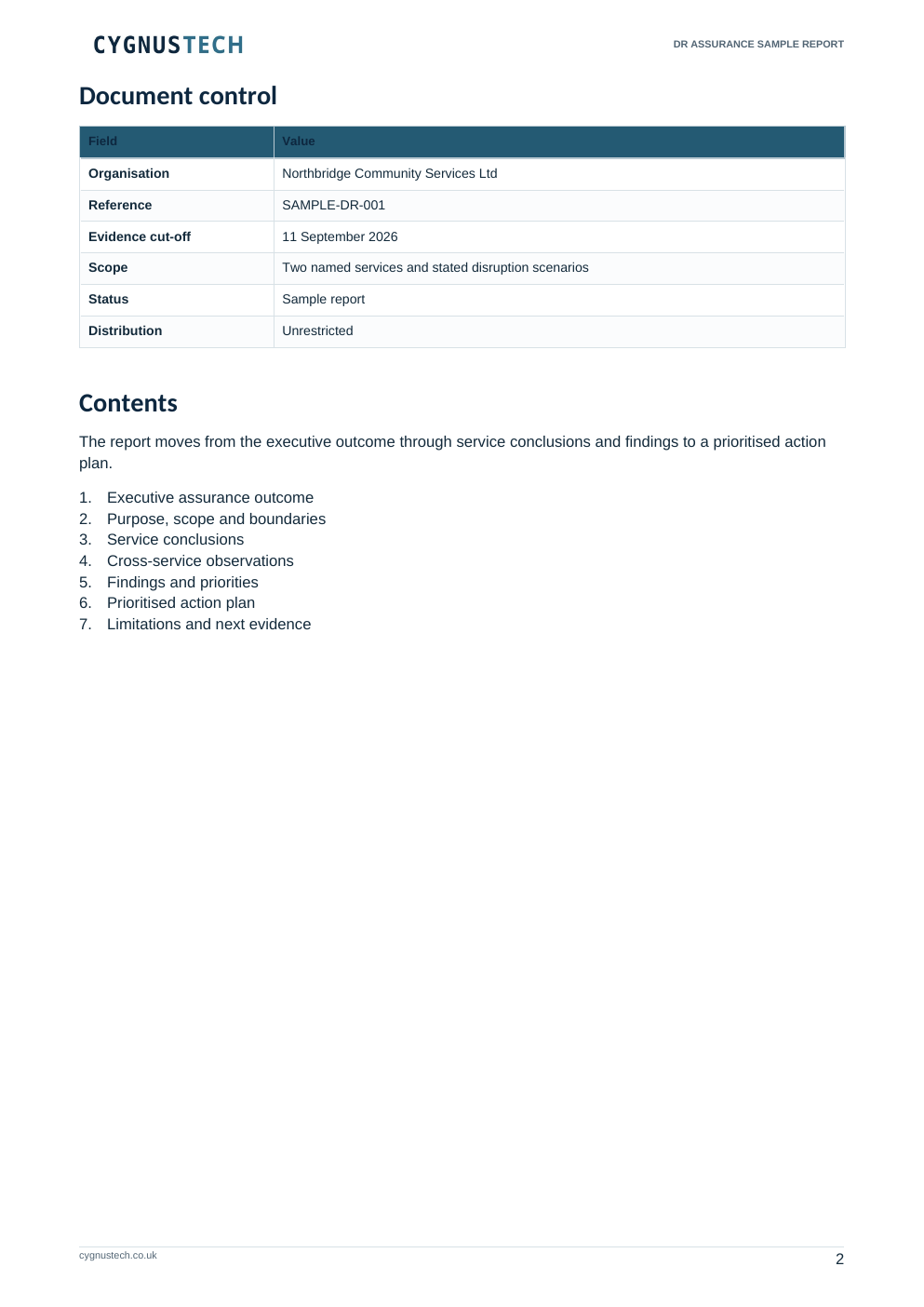
The report tells senior stakeholders how ready each service is to recover, then gives infrastructure teams the findings and actions needed to improve it.
See how service findings, recovery priorities and recommended actions are presented.
After the review
The review can stand alone or provide the starting point for recovery improvements.
Define a realistic scenario, success criteria, authority, safety controls and the results to record.
Observe an exercise run by the client and report what worked, what did not and what remains untested.
Improve procedures and address important technical or ownership gaps.
Review the service after improvements, or revisit it as technology and obligations change.
Live restore, failover and production change are not included in the review. Where needed, they can be planned as separate engineering work with the appropriate change controls.
DR guidance
Use the guidance most relevant to the question your team is trying to answer, then follow the evidence into the checklist, example report or review.
A practical guide to testing service recovery, including scenarios, dependencies, success criteria, evidence, limitations and retesting.
Read the articleThe records a DR test should retain to show its scope, technical results, service validation, limitations, decisions and required actions.
Read the articleHow to compare a stated recovery time objective with the full measured route from disruption and invocation to a usable, accepted service.
Read the articleWhy successful backup jobs do not prove that a critical service can recover, and what infrastructure teams should validate instead.
Read the articleDR resources
Read the article, work through the checklist with your team and see the format of the final report.
See why backup success, a successful restore and usable service recovery are different capabilities.
Read the articleApply structured prompts to one important service and record the basis for each answer.
Use the checklistSee how service findings, recovery priorities and recommended actions are presented.
View the sample reportFrequently asked
The review considers backup and restore records alongside service scope, recovery targets, dependencies, runbooks, decision-making and previous exercises. The report covers the services and disruption scenarios agreed at the start.
No formal DR programme is required. The review can start with one or two important services or a specific recovery concern. Larger service populations can be divided into practical groups, with shared recovery foundations reviewed once and linked to each relevant service.
Cygnus has practical experience across Veeam, Azure, AWS and VMware. The review is organised around recovery capability and can span the platforms supporting the service.
The review assesses existing plans, technical records and previous test results; it does not run a live restore or failover. If a new exercise is needed, Cygnus can help plan and witness one operated by your team.
Yes. Cygnus can help plan recovery exercises, improve runbooks, advise on remediation and reassess the services after changes are made. Restore and failover engineering can also be agreed as a separate engagement.
Start a conversation
Tell us which services matter most, what could disrupt them and when recovery was last tested. We will suggest a practical starting scope.