
Disaster Recovery evidence should allow somebody who was not present during the test to understand what was attempted, what happened and how far the result supports the recovery claim.
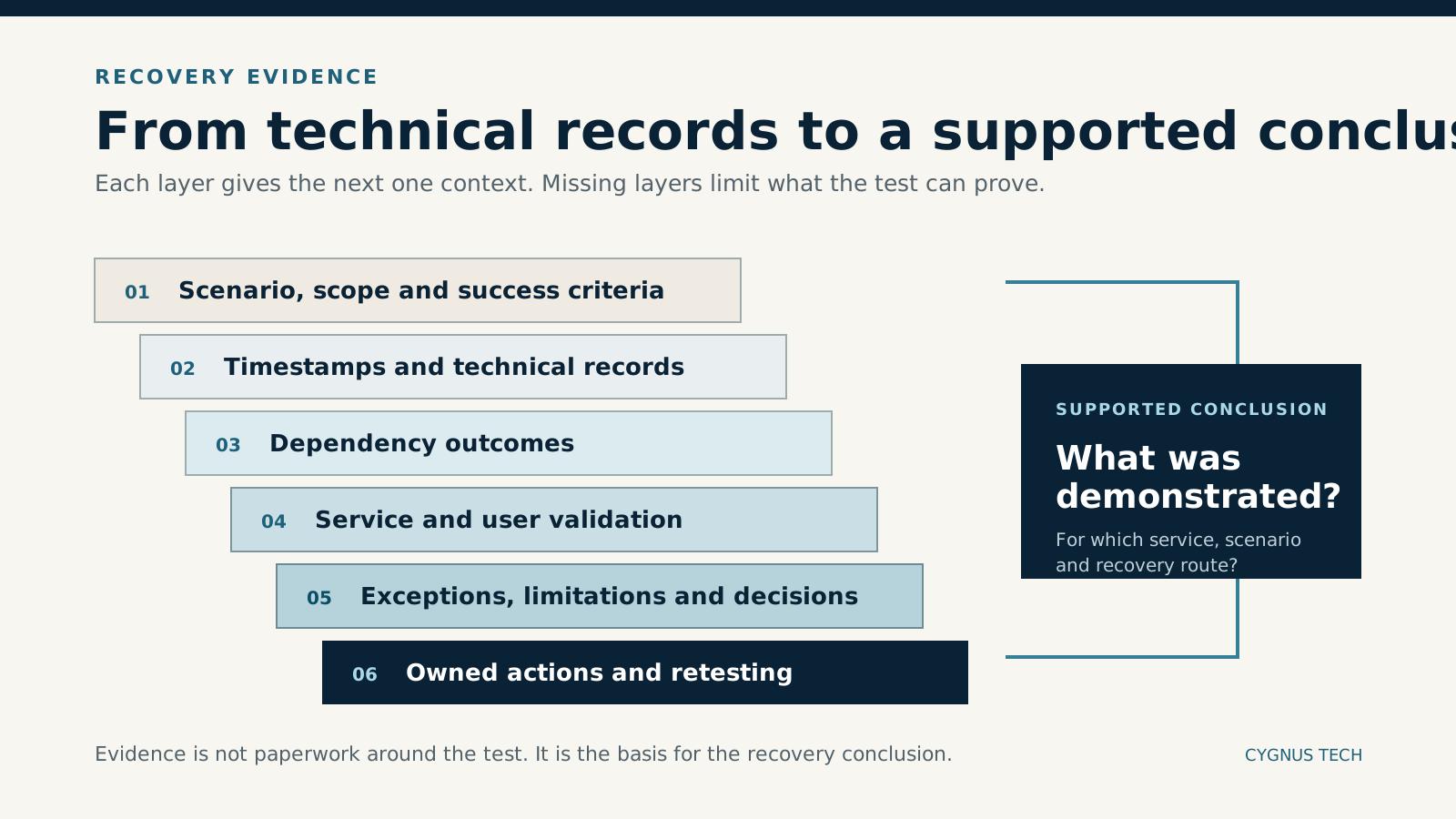
That requires more than screenshots of successful backup jobs or a statement that the application was available. A useful evidence pack connects the agreed scenario and scope to technical output, dependency outcomes, service validation, exceptions, decisions and follow-up actions.
Evidence starts before the test
Without a defined question, the results are difficult to interpret. The test record should begin with the basis on which the exercise was run:
- the service and disruption scenario;
- the recovery route and environment used;
- the recovery time objective (RTO) and recovery point objective (RPO) being examined;
- the components and dependencies included;
- explicit exclusions and assumptions;
- the test date and evidence cut-off;
- named technical and service owners; and
- observable success criteria.
This information prevents the conclusion expanding beyond the work performed. A component restore can be valuable evidence without being presented as a complete service-recovery result.
Record a trustworthy timeline
The timeline should show the complete sequence rather than only the duration of the restore task.
Record when:
- the scenario began or was declared;
- the decision to invoke recovery was made;
- the team obtained access and began technical work;
- data, workloads and material dependencies became available;
- the application was started;
- technical and user validation completed; and
- the service owner accepted the recovered service.
Where activity paused, record why. Approval, access, missing information, supplier response and manual investigation are part of the demonstrated recovery time when they would also apply during a real incident.
Retain the technical records that support each step
The exact artefacts depend on the platform, but they should show the state and outcome of the important recovery actions.
Examples include:
- backup, replication, snapshot and restore job output;
- recovery-console or orchestration records;
- infrastructure and application health checks;
- data-reconciliation or integrity results;
- identity, DNS, network and certificate checks;
- configuration changes made for the recovery route;
- monitoring and alerting status; and
- relevant log extracts with their timestamps and source.
Screenshots can help, but exported job data or retained machine-readable records are usually stronger. They are easier to reconcile, search and compare with later tests.
Each artefact should have enough context to identify the system, time, action and result. A cropped image containing a green tick but no workload, date or environment is weak evidence.
Show what happened to service dependencies
Recovery tests often concentrate on the application components while assuming the foundations around them. The evidence pack should show how material dependencies were treated.
For each important dependency, record whether it was:
- recovered during the exercise;
- already available through a resilient design;
- simulated or substituted;
- deliberately excluded; or
- not considered.
This applies to identity, privileged access, DNS, network paths, firewalls, load balancers, storage, secrets, certificates, external services and operational tooling.
An assumption may be reasonable for a particular exercise. It becomes a problem when it is invisible and the result is later described as end-to-end recovery.
Include service and user validation
Infrastructure health confirms that components are running. It does not confirm that the service is fit to return.
Validation evidence should be tied to the success criteria agreed before the exercise. It might include:
- successful authentication through the recovery route;
- completion of representative user transactions;
- confirmation that data is present and internally consistent;
- connectivity to required third parties;
- confirmation that scheduled or integration processes operate correctly;
- monitoring and support readiness; and
- formal acceptance by the responsible service owner.
Where representative user testing is unsafe or impractical, record the alternative validation used and the uncertainty that remains.
Capture exceptions, workarounds and decisions
Recovery rarely follows the procedure exactly. Unexpected behaviour is valuable evidence when it is recorded honestly.
The record should identify:
- failed or repeated steps;
- workarounds used;
- undocumented knowledge required;
- changes made during the exercise;
- decisions to continue, pause or alter scope;
- who had authority to make those decisions; and
- any effect on the conclusion or measured time.
Do not rewrite the final runbook and then report the test as though the improved version had been followed. Keep the version used during the exercise and record the resulting update as an action.
Protect evidence quality and provenance
The evidence set should identify where each record came from and when it was collected. Keep original system output where possible, with a simple index connecting artefacts to test steps and findings.
Apply access controls appropriate to the contents. Recovery evidence can contain infrastructure names, account details, IP addresses, security configuration and other sensitive information. Store it in an approved location with an agreed retention period.
If evidence is copied into a report, retain a link or reference to the source. This allows later reviewers to distinguish a summary from the underlying technical record.
Turn the evidence into a bounded conclusion
The evidence should support a clear answer for each service recovery route:
- what was demonstrated;
- whether the success criteria were met;
- the measured recovery time and point;
- which dependencies and conditions were represented;
- what remained untested or uncertain; and
- what needs to happen next.
Avoid replacing this reasoning with a single maturity score. One missing credential or untested dependency can be more important than a high average across a long checklist.
The conclusion should be understandable to senior stakeholders without removing the technical basis teams need to act.
Close findings with evidence, not status
Each material finding needs an owner, priority, target date and closure test. Closing a task because a procedure was updated is not the same as showing that the revised procedure works.
Retesting should produce a new evidence trail and state whether the earlier limitation has been resolved. This creates a defensible history of recovery improvement rather than a collection of disconnected exercise reports.
A practical evidence-pack structure
A concise pack can contain:
- scope, scenario, targets and success criteria;
- recovery plan and participant roles;
- timestamped activity log;
- indexed technical artefacts;
- dependency and service-validation results;
- exceptions, decisions and limitations;
- service-level conclusion; and
- prioritised actions and retest requirements.
The DR Readiness Checklist helps identify which records should exist for one important service. The DR Assurance Sample Report shows how the evidence can be translated into conclusions and actions. For an independent review of the available evidence, see Technical Disaster Recovery Assurance.