
A four-hour recovery time objective can look precise while leaving the most important measurement questions unanswered. When does the clock start? What counts as recovered? Which delays are included? Which disruption scenario does the target apply to?
Until those points are defined and tested, the RTO is an expectation rather than demonstrated capability.
Define the start and finish
The recovery time objective (RTO) is the target duration for restoring an agreed level of service after a disruption. It should be connected to business impact and a defined recovery scenario.
Teams commonly start the clock at different points:
- when the underlying fault occurs;
- when monitoring detects it;
- when an incident is declared;
- when the recovery decision is authorised; or
- when the technical restore begins.
Those differences can remove hours from the reported result.
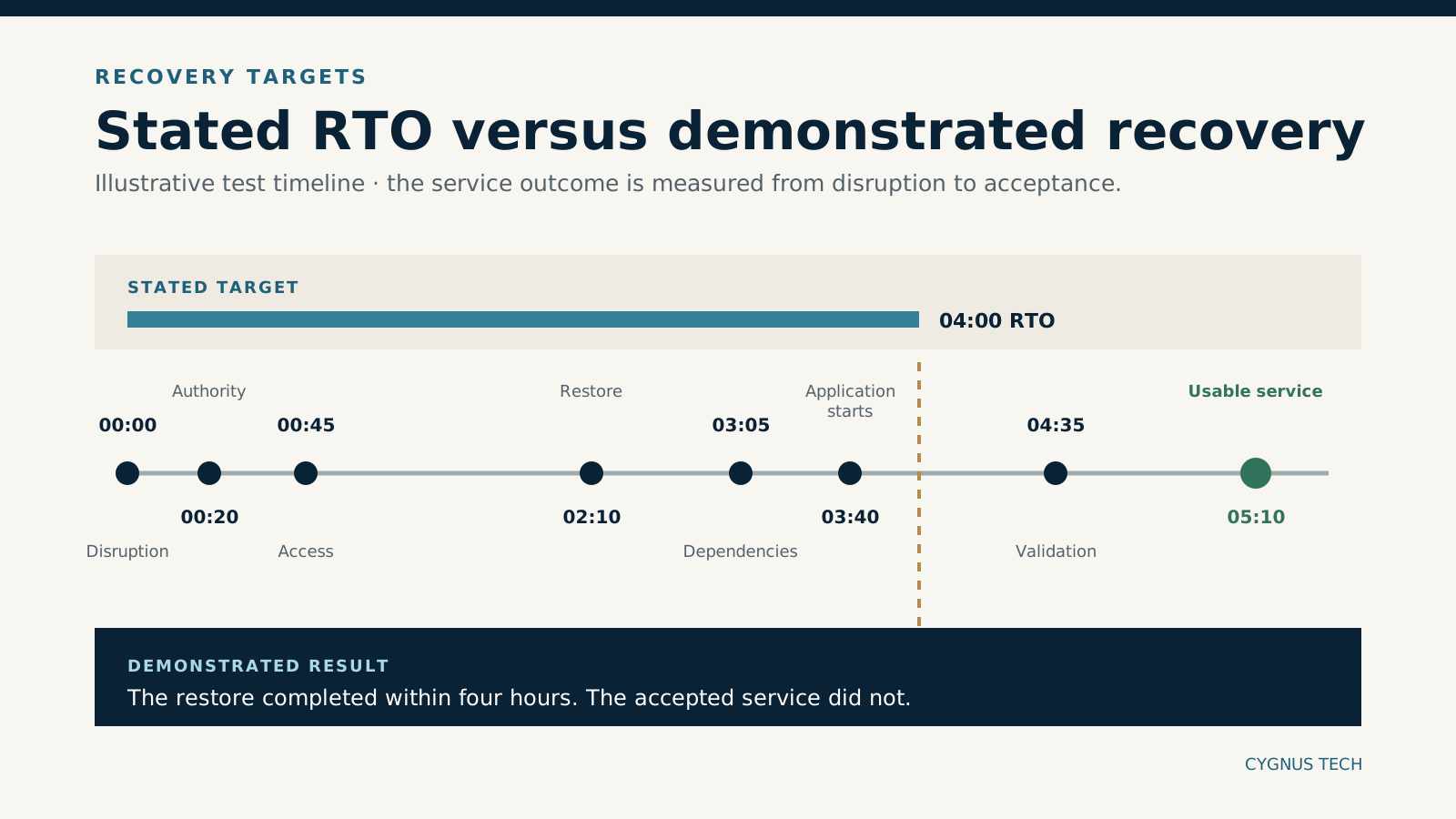
The finish point is equally important. A server being powered on, a database opening or an application responding to a health check may be an important milestone. The service is not necessarily recovered until its dependencies work, representative transactions succeed and the responsible owner accepts it for use.
Measure the complete recovery route
A defensible measurement follows the sequence the organisation would need during the stated scenario:
- detect and assess the disruption;
- obtain the authority to invoke recovery;
- assemble the required people and gain emergency access;
- recover infrastructure, data and applications;
- restore or confirm material dependencies;
- complete technical and user validation; and
- accept the service for return.
If the target excludes part of this route, document the boundary. A separate technical restore objective may be useful, but it should not be presented as the whole service RTO.
Include organisational delays
Recovery plans often assume that the right people, credentials and decisions will be immediately available. Exercises reveal whether that assumption is realistic.
Material delays can include:
- uncertainty over who can invoke DR;
- waiting for a service owner, supplier or security approver;
- locating emergency credentials or recovering privileged access;
- interpreting an incomplete runbook;
- approving DNS, firewall or routing changes;
- identifying the correct recovery point; and
- deciding whether validation is sufficient to return the service.
These are not administrative distractions. If they would delay recovery during the scenario, they form part of the capability being measured.
Test the dependencies behind the target
An RTO normally belongs to a service, but the recovery design may treat it as a collection of independent components. Shared dependencies can make the target impossible even when every component has a plausible restore time.
Check whether the service relies on:
- identity or privileged-access services with a slower recovery route;
- network, DNS or load-balancer changes that require another team;
- data services that must be recovered in a particular sequence;
- certificates, keys or secrets stored in the affected environment;
- external suppliers with different continuity commitments; or
- a constrained recovery platform shared by higher-priority services.
The target must account for the slowest material dependency and the order in which resources and people are available.
Use representative evidence
A design review can establish whether the target is plausible. Demonstration requires an exercise that represents the material conditions closely enough for the result to be useful.
The test record should show:
- the scenario and assumed point of disruption;
- the start and completion timestamp for each material stage;
- the environment, data and recovery route used;
- which dependencies were recovered, available, simulated or excluded;
- service-validation results;
- pauses, retries, workarounds and decisions; and
- the point at which the service owner accepted recovery.
The guide What evidence should a Disaster Recovery test produce? provides a fuller evidence-pack structure.
Account for favourable test conditions
Exercises are often run during business hours with advance notice, the most experienced engineers present and recovery documentation already open. Data may be pre-staged and the recovery platform may have spare capacity.
These controls can be appropriate for safety, particularly during an early exercise. They should appear in the conclusion because they affect how confidently the measured time can be applied to an unplanned incident.
Other important differences can include:
- smaller data volumes;
- an isolated application component rather than the full service;
- dependencies left running in the primary environment;
- normal identity and communication tools remaining available; and
- validation being performed by the project team instead of representative users.
A controlled result can still be valuable. The important point is to state what it demonstrates.
Compare the target with a range, not one perfect run
One successful exercise is evidence, but it is not a permanent guarantee. Recovery time changes with data growth, platform changes, staff availability, competing incidents and the nature of the disruption.
Where enough evidence exists, compare several tests and explain the conditions behind the quickest and slowest results. A range with known causes is often more useful for decision-making than a single precise number.
Reassess the target when the service, platform, dependency or operating model changes materially. A result from the previous architecture may no longer support the current recovery claim.
Decide what to do when the RTO is unsupported
Missing the target does not automatically mean purchasing new recovery technology. The evidence may show that the most important delay is invocation, access, sequencing, documentation or validation.
Prioritise actions according to their effect on the service outcome. Typical improvements include:
- clarifying recovery authority and escalation;
- making emergency access independent of the affected service;
- improving dependency mapping and recovery order;
- automating a repeatable technical step;
- reducing data-transfer or restore time;
- defining faster service-validation checks; and
- agreeing a different target where the business requirement or investment case has changed.
Each material change should have an owner and a retest requirement.
From stated objective to demonstrated capability
Take one critical service with a documented RTO and trace the latest test from disruption to accepted service. If the evidence begins at the restore job or ends at infrastructure health, the current result does not yet demonstrate the complete target.
The DR Readiness Checklist helps compare recovery targets with the available design and exercise evidence. The DR Assurance Sample Report shows how supported and unsupported recovery conclusions can be presented. Technical Disaster Recovery Assurance provides an independent review of the services and scenarios that matter.