
Checklist · VMware Modernisation
VMware Modernisation Readiness Checklist
A practical self-assessment for teams preparing for a VMware renewal, upgrade, consolidation or migration decision.
Download it, use it with your team and record the basis for each answer.
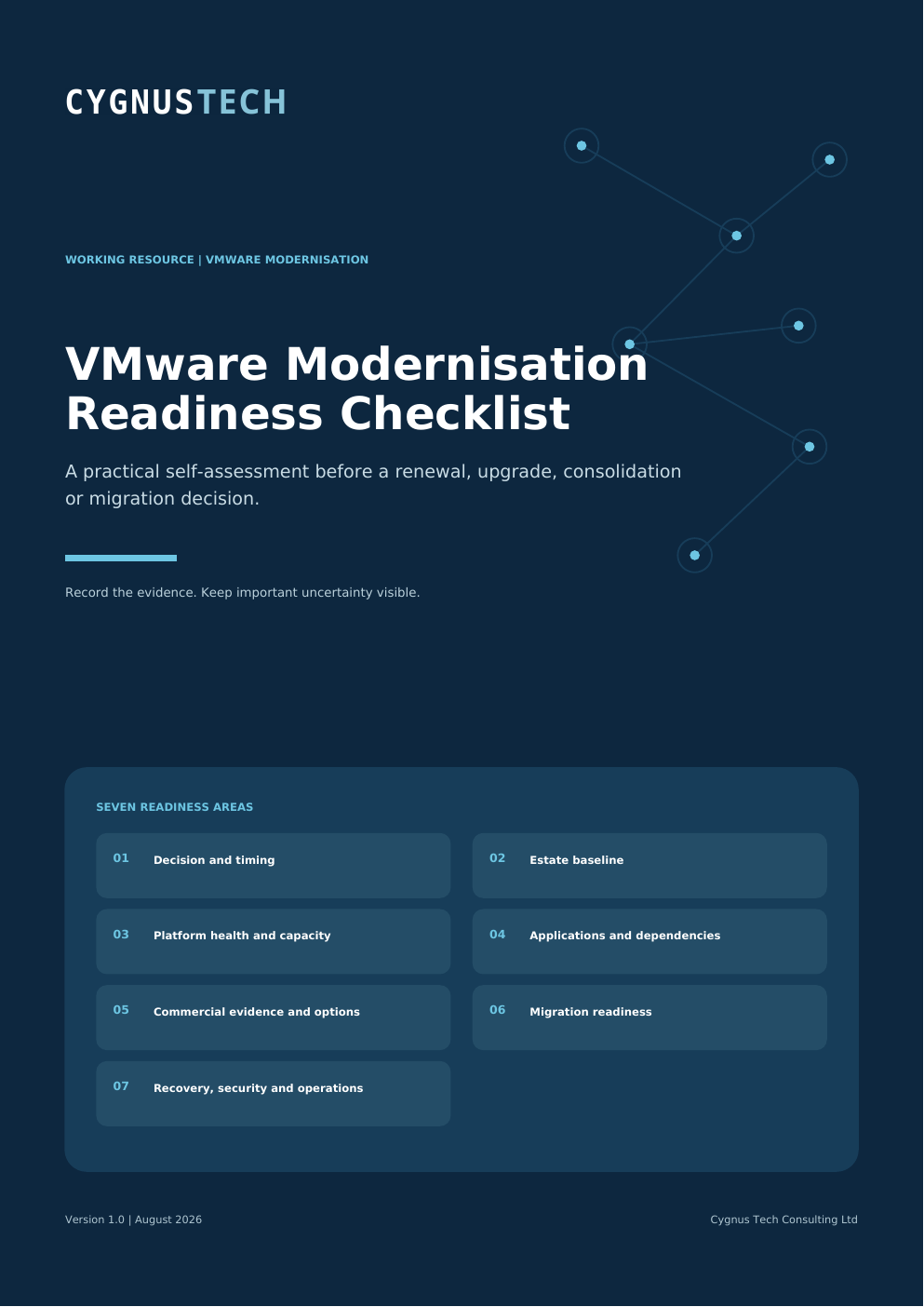
Use this checklist before committing to a VMware renewal, upgrade, consolidation or migration programme. For each prompt, record whether the answer is evidenced, partly evidenced, unknown or not relevant. Keep the supporting source and owner beside the answer; a percentage score can hide one important constraint.
1. Decision and timing
- The decision that must be made has a named sponsor and technical owner.
- Renewal, hardware, support or data-centre deadlines are recorded.
- The business and operational outcomes are clearer than a preferred product.
- Retain, improve, move and mixed options can be considered where credible.
- The people who can approve the platform direction and funding are identified.
2. Estate baseline
- Sites, vCenters, clusters, hosts and failure domains have been reconciled.
- ESXi, vCenter and related component versions and builds are known.
- Server, storage and network hardware support positions can be checked.
- Powered-off VMs, templates, snapshots and unclear workloads remain visible.
- NSX, vSAN, VCF, Horizon and other specialist components are explicitly in or out of scope.
3. Platform health and capacity
- High availability, DRS, admission control and failure-domain assumptions are understood.
- Capacity and performance decisions use representative history, not only a point-in-time inventory.
- Patching, certificates, identity, privileged access, monitoring and alerting have accountable owners.
- Storage and network dependencies are understood beyond datastore and port-group names.
- Any consolidation opportunity will be validated against resilience, performance and growth needs.
4. Applications and dependencies
- VMs and non-VM components are grouped into applications or business services.
- Important services have business and technical owners, criticality and outage constraints.
- Identity, DNS, network, data, certificate, secret and supplier dependencies are recorded.
- Application and vendor support requirements can be checked for each credible target.
- Data residency, regulatory and security requirements are attached to the affected workloads.
5. Licensing, cost and options
- Current quotations, entitlement records and renewal assumptions are available from accountable owners.
- Deployed host and physical-core quantities have been reconciled to the agreed technical scope.
- Commercial scenarios are separated from legal or software licence-compliance conclusions.
- Each credible target is compared against the same service, operational and security requirements.
- Important assumptions have an owner and a validation action before commitment.
6. Migration readiness
- Target-platform, landing-zone, connectivity and operating-model prerequisites are visible.
- Migration methods are matched to application, data, outage and compatibility needs.
- Rollback triggers, validation checks and decision authority can be defined for each move.
- Shared services and dependencies can be sequenced before the workloads that rely on them.
- A pilot or proof of concept is planned where an assumption could reverse the target decision.
7. Recovery, security and operations
- Backup and disaster-recovery implications are understood for the source, transition and target states.
- Recovery targets are not assumed to transfer unchanged to a new platform.
- Security controls, administrative access and governance are designed for the target operating model.
- Monitoring, patching, capacity, vendor support and skills have clear future owners.
- Decommissioning, data disposal, configuration records and operational handover are included in the plan.
Interpreting the result
Concentrate first on unknowns that could reverse the platform decision, block a critical workload or make a migration unsafe. A good next step may be better information, a vendor confirmation, a focused pilot or a specific architecture decision rather than a migration.
The Cygnus VMware Modernisation Assessment provides a recommended platform direction, supporting findings and a prioritised roadmap.